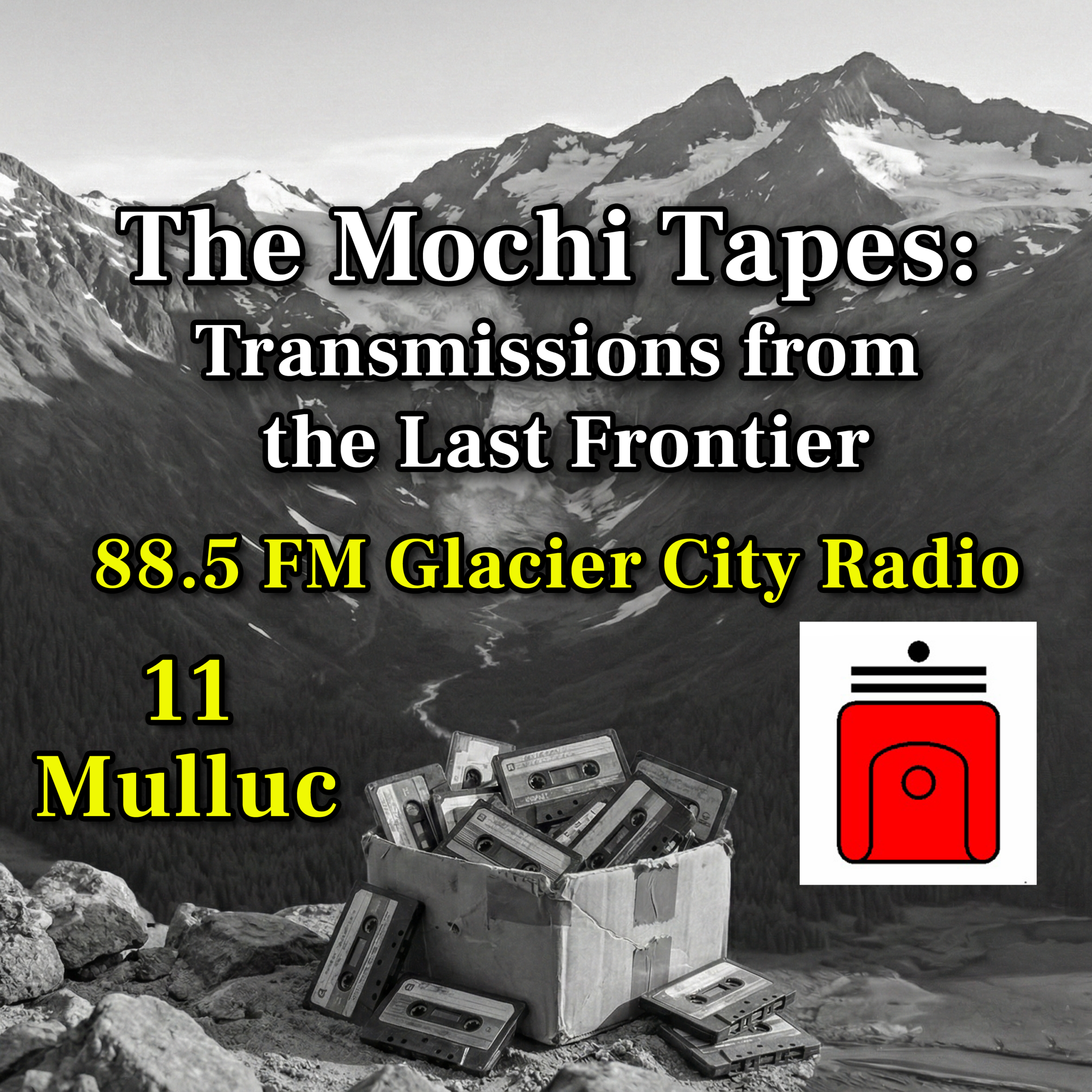
The early morning air of September 8, 1997, arrived in the Girdwood valley as a thick, multi-hued gray, a wet Alaskan Tuesday defined by a persistent rain that seemed to dissolve the edges of the jagged landscape. As the community began the slow process of crawling out of bed at 6:20 AM, the atmosphere was pierced by the mellow vibrations of 88.5 FM Glacier City Radio, a low-power pirate signal that served as the valley’s spiritual and sonic lighthouse. Through the heavy mist, the ancient glaciers would occasionally reveal their crystalline forms, grounding the ethereal broadcast in the raw physical reality of the Last Frontier. This specific broadcast began with a striking synchronicity, as the DJ known as Mochi noted that the day’s Mayan signature was 11 Muluc—the sign of the raindrop. This cosmic alignment between the literal weather falling on the Girdwood valley and the Mayan “cosmic seed” of awakened consciousness set a profound tone for the morning, suggesting that the falling rain was not merely a meteorological event, but a ritual of purification and communication for a town still half-submerged in sleep.
The source of these magnetic artifacts was a literal architectural beacon: the turret of a house owned by Lewis Leonard, which had been transformed into a vessel for the Girdwood Community Club’s experimental broadcast project. Operating this DIY transmitter was Mochi, a nomadic cultural worker who, at the time of these recordings, lived a precarious existence in a tent or a remote cabin. This contrast between the elevated turret and Mochi’s ground-level nomadic reality imbued the “Mochi Tapes” with a singular tension, acting as a bridge between the isolated residents of the ski town and a larger, more experimental world of thought. The station was more than a hobby; it was a communal hub where the “inner pressure” of life in the Alaskan wilderness could find a voice, broadcast from a turret that functioned as a site of both observation and transmission in a landscape that often felt indifferent to human presence.
Mochi’s broadcast that morning was heavily dictated by the spiritual pulse of the day, weaving together the Mayan calendar with the evocative imagery of the Sabian symbols. With the moon sitting in Libra and the sun at the 17th degree of Virgo, Mochi interpreted the day’s symbol—a volcanic eruption—as a necessary and spectacular catharsis of the subconscious. He urged his listeners to view this explosive energy as a tool for liberation, a way to shatter the outer shell of egoic consciousness and release the repressed frustrations of the past. The soul, he argued, must become empty and translucent to reach a transfigured state, and the rhythmic rain outside served as the perfect metaphor for this “purification by fire.” In Mochi’s world, the act of tuning in was an invitation to let go of old patterns and embrace the “explosive energy” required to survive the dehumanizing effects of a broader capitalistic society.
This spiritual urgency was mirrored in a sonic tapestry that drew from the heights of 20th-century soul and rock, transforming the playlist into a ritual manifestation of the day’s themes. The broadcast moved from the deep, devoted longing of Bootsy Collins’ “I’d Rather Be With You” to the somber, existential weight of Pink Floyd’s “Time.” As the lyrics of the latter spoke to the “quiet desperation” of the English way and the terror of realizing ten years have slipped behind you, the music captured the specific anxiety of the late-90s underground. This mood was further deepened by the inclusion of The Clash’s “Straight to Hell,” with its haunting reflections on urban alienation, and the Italian survivalism of Vasco Rossi’s “Vivere.” Rossi’s lyrics, which describe the paradox of living even when one feels “dead inside,” resonated with Mochi’s earlier call for a transfigured state, while surreal lyrical reflections on being “scared of whoever this is living in my skin” underscored the morning’s introspective and occasionally darker musical mood.
Despite these soaring philosophical heights, the broadcast remained tethered to the tangible rhythms of the Girdwood community through local dispatches that grounded the metaphysical in the mundane. Mochi seamlessly shifted from the “spectacular catharsis” of the stars to the upcoming Girdwood Center for the Visual Arts (GCVA) silent art auction, scheduled for Saturday, September 13th. This community event, hosted at the home of David and Lori Sears, promised a spaghetti feed and a pie-baking contest overseen by “honest pie judges.” With tickets priced at ten dollars for individuals and twenty-five for families—and a local named Valia serving as the point of contact—these announcements served to remind the listeners that even amidst a volcanic eruption of the soul, the social fabric of the valley remained intact. It was a moment where art bargains and communal meals functioned as the practical application of Mochi’s higher-life principles.
Decades later, the discovery of these lo-fi dispatches in a discarded cardboard box within an old cabin offers a hauntingly preserved cultural time capsule of a specific Alaskan era. These tapes document the journey of an individual navigating the “inner pressure” of time and change through the medium of pirate radio, providing a permanent record of a Tuesday when a nomadic DJ could still hold the collective attention of a community waking up amidst the mist. The Mochi Tapes are more than just a playlist; they are the audio remains of a transfigured state of media, captured before the nomadic movements of the host and the inevitable march of time took hold. As the rain eventually ceased over the glaciers back in 1997, these recordings remained, serving as a testament to a moment when the airwaves of 88.5 FM were the only thing keeping the quiet desperation of the world at bay.

Leave a Reply